





IIAR Chile Chapter Breaks Attendance Record, Paraguay Adopts IIAR-2

IIAR's Chile Chapter, along with The Chilean Chamber of Refrigeration and Air Conditioning, said the organizations' twenty-eighth Seminar on Natural Refrigeration for Latin America drew over 350 attendees, the largest number of attendees in the event's history. “This was the largest IIAR event yet in Chile,” said Yesenia Rector, Vice President of Education, Outreach, and Events.

Read More
Creating Your Pressure Vessel Replacement Framework

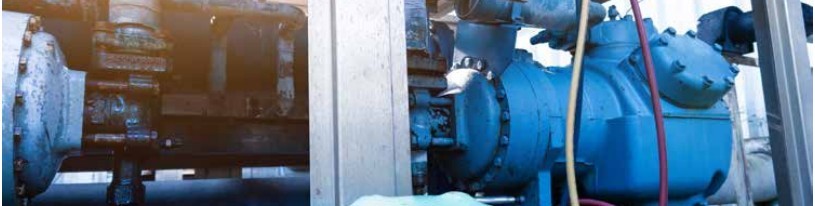
When it’s time to replace a pressure vessel in an industrial refrigeration system, the stakes can be high and the questions are many. To help operators, engineers, and manufacturers navigate this complex process, IIAR recently hosted a member webinar titled Considerations for Pressure Vessel Replacement. The presentation laid out a question-and-answer framework designed to guide decision-making and ensure long-term mechanical integrity for your refrigeration system.

Read More
IIAR Delivers IIAR 9 Training at RETA

The International Institute of All-Natural Refrigeration delivered its IIAR 9 Certificate Course at the RETA 2025 National Conference Oct 18 and 19 in Spokane, WA. IIAR said it plans to deliver a course for IIAR 6-2025 during the RETA 2026 National Conference. IIAR 9 provides the minimum safety requirements for existing closed-circuit ammonia refrigeration systems as well as provides a method to determine if existing stationary closed-circuit refrigeration systems using ammonia as a refrigerant comply with the minimum system safety requirements. Tony Lundell, IIAR’s Senior Director of Standards and Safety delivered the course.

Read More
Energy Efficiency: To Reduce Energy Expenditure, Lower Cost, Clean Evaporator Coils

Numerous factors can contribute to decreases in a refrigeration system’s energy efficiency, not the least of which is its cleanliness. Much of the time, when facility operators see a facility’s efficiency drop, they believe that indicates they must replace the systems with larger units, when in fact, they often simply need to clean the systems they’re currently using - particularly the evaporators. The evaporator is the component of a closed-circuit refrigeration system that absorbs heat by vaporizing liquid refrigerant. The evaporator coil is the part of the system not enclosed in a pressure vessel. There are two types of evaporators: forced draft, in which air is pushed through the coils, and induced draft, with air pulled through the coils by fans.

Read More
Lesson Learned: Where’s that vapor going?

Where’s that vapor going? Sooner or later that question must be answered when some type of work is required on an ammonia refrigeration system. To accomplish the work, the system may have to be opened, and later that portion of the system pressure tested. The pressure testing process will typically involve some amount of ammonia used in the final test, after which the pressure is removed again before the portion of the system tested is placed back into operation.

Read More
IIAR Government Affairs

On September 30th, The Environmental Protection Agency (EPA) announced a proposed rule to reconsider policies contained in the Technology Transitions Rule under the American Innovation and Manufacturing (AIM) Act. The AIM Act, passed in 2020, directs EPA to address hydrofluorocarbons (HFCs) in three main ways.

Read More
IIAR Releases Hydrocarbon and Ammonia Fact Sheets

The International Institute of All-Natural Refrigeration (IIAR) has released two new fact sheets – the Hydrocarbon and Ammonia fact sheets to meet growing demand for accessible, technically sound guidance on natural refrigerants. The newly released fact sheets are part of a trio of refrigerant summaries, including one previously released for CO2. All three cover safety considerations, system guidelines, and design considerations.

Read More
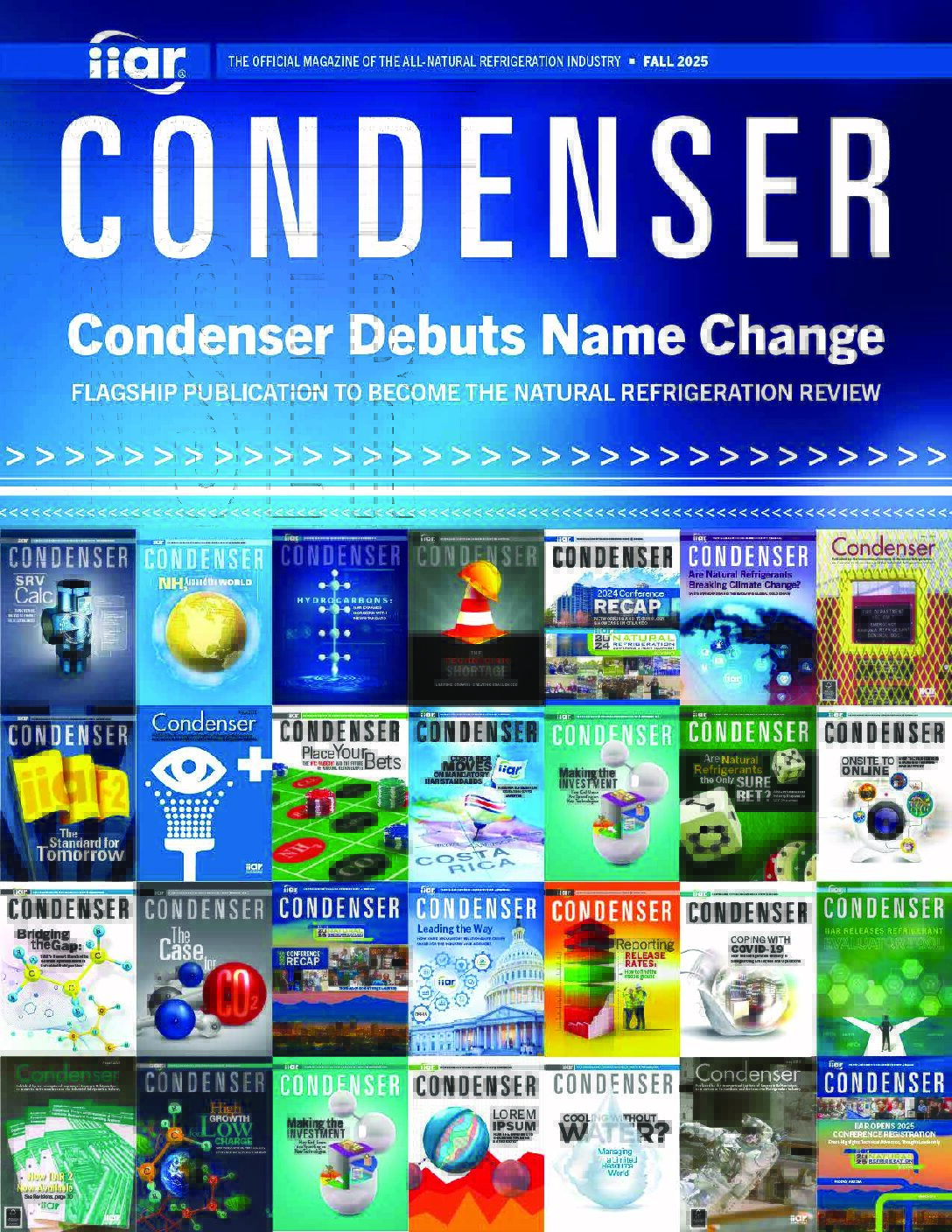
Condenser Debuts Name Change: Flagship Publication to Become Natural Refrigeration Review

After a 30-plus-year run as the Condenser magazine, the International Institute of All-Natural Refrigeration said its long-running member journal will be rebranded in 2026 to become the Natural Refrigeration Review. IIAR said the organization's Board of Directors voted for the change as a way to reflect the expansion of the publication in recent years. The rebranding follows the IIAR's name change for both the Institute and the Foundation.

Read More
President’s Message: Announcing the IIAR Resource Center

One of the greatest strengths of IIAR is our ability to turn out educational and informational resources with the technical rigor you’d expect from a group of engineers that first convened to develop safety standards for their industry and haven’t quit since. In these days of information overload, our commitment to producing real, vetted resources for our industry – and each other – carries that energy forward. It comes out at our meetings, where I can’t make it down a hallway without hearing a new proposal for a new fact sheet, whitepaper, policy analysis or obscure detail that needs addressing in our ever-evolving suite of standards.

Read More