







NRF Research Validates CO2 Standard
A new research project funded by IIAR’s Natural Refrigeration Foundation has validated a key calculation used in the ANSI/IIAR CO2-2021 Safety Standard for Closed-Circuit Carbon Dioxide Refrigeration Systems.
The calculation is used to generate a formula that determines the CO2 relief valve sizing recommendations in the CO2 safety standard. While the validation of that formula provides valuable data for IIAR, it emerged from the early phases of a larger research project focused on the behavior of CO2 in a supercritical state – a project currently underway at the University of California, Berkeley.
“This is very exciting for us because how often do we get the chance to do the science unique to our industry that validates the real data behind a standard?” said Bill Greulich, Chair of the IIAR Research Committee.
“Right off the bat, Berkeley has validated our CO2 standard with our test equipment. We’re already getting real data, and our vessel is already operating outside the historical ASHRAE description of CO2” which assumes subcritical conditions.
The project is funding doctoral candidate work on CO2’s behavior in a supercritical state, primarily to determine why dry ice may form in overpressure protection systems during standstill events, where CO2’s low critical temperature and high triple point pressure create unique pressure conditions. “We need to understand the formation of dry ice in relief piping during these events,” said Bruce Nelson, IIAR’s past Chairman. “CO2 is a very unusual refrigerant, very unlike other working fluids that we use as natural refrigerants. It is a tremendous and useful refrigerant, but it doesn’t behave itself in certain cases and has to be treated differently.”
Observing and understanding these differences will help us improve design and safety practices, which is the reason we’re doing this research,” he said, adding that IIAR was fortunate in identifying UC Berkeley as having the background and qualifications to partner with NRF to do the work.
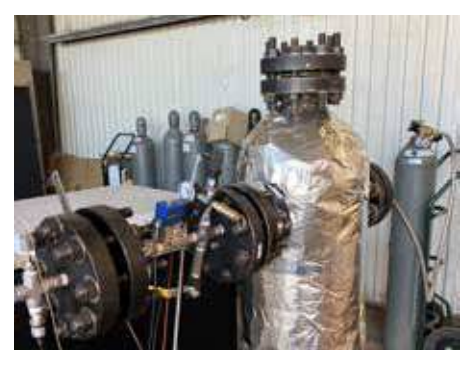
The project “will look to advance some fundamentals of the deep pressurization process for CO2,” said Greulich, adding that the initial validation of the data behind IIAR’s CO2 standard came out of a smallscale experiment that is being used to finish the initial benchmarking work required to build a larger testing laboratory.
“It’s in that testing that we’re seeing validations,” said Greulich. “As we’re building up to the full experiment, we have to make sure we fine-tune our ability to understand the inlet conditions [of the test vessel], and it’s in that process that we’re seeing the first data.”
“Right at the beginning of this process, we got a critical piece of data, the mass flow rate over time. It’s that data that validates the approach we’ve used in the CO2 standard.”
The mass flow rate over time is the calculation that underpins the equation, called the capacity calculation, that IIAR uses to generate the latest version of the CO2 relief valve sizing formula that appears in the CO2 standard.
For those unfamiliar with the fluid dynamics of CO2, the significance of validating something as basic as a capacity calculation may not seem like much of a big deal. However, the implications this validation has for advancing the CO2 safety standard – and the opportunities it presents to the industry – are significant, said Greulich.
“CO2 is a very interesting refrigerant, it’s different than the refrigerants we’re used to working with, that we operate in a sort of normal physics range,” he said. “CO2 is in a kind of fourth state of matter in high pressure, it’s in none of these three states, it’s in a supercritical state where it’s both gas and liquid.”
“Supercritical fluids behave in interesting ways [that we don’t fully understand], that’s why the current ASHRAE-15 guidance on sizing relief valves was based on CO2 operating in ‘normal’ conditions, not in a supercritical state,” said Greulich.
The new data Berkeley generated describes CO2 in a supercritical state, validating the science behind the capacity calculation with an actual observation.
Nelson said the new data generated by the project may help IIAR and ASHRAE harmonize CO2 standards, but the overarching goal is to improve design practices for CO2 systems.
“With this project, we’ve already learned some very interesting things about CO2. We don’t know all the answers yet, but this project will hopefully provide us with the answers that will make their way into our safety standards.”
Currently, “there’s a gap in our knowledge and a need for research that results directly from two characteristics of CO2,” said Nelson.
First is the low critical temperature of CO2, at 88 degrees Fahrenheit, the point at which the distinction between CO2 liquid and vapor disappears.
Second is the high triple point pressure of CO2, at ~75 psi. The triple point is the point at which liquid, vapor, and solid can all coexist.
“The challenge with CO2 is the low critical temperature and high triple point pressure,” said Nelson.
“The reason we’re doing this research and the potential problem we don’t fully understand has to do with this high triple point pressure. A potential problem arises when you have a vessel that contains liquid and vapor under normal operating conditions that has a safety relief set point that is at a supercritical pressure.”
“In this case, the possibility exists for dry ice to form in the safety relief piping during a relief event. We don’t really know when and how this dry ice might form – it’s unpredictable, and we really don’t fully understand the physics at play yet.” While the Berkeley research project is specifically focused on answering that question, the significance of the NRFfunded research may have implications beyond natural refrigeration.
“There’s room here to advance the state of knowledge around supercritical fluids in general,” said Greulich, adding that the project is an opportunity to advance the entire knowledge base of CO2.
The next phase of the project will be to build the final 160L vessel, said Greulich. “That’s ultimately the vessel that will anchor the high-pressure rig for CO2. Once this vessel comes online with all the validating data from the 53L test vessel, that will be where the rubber meets the road on this project.”
“We’re close to one year in with Berkeley on this work, and we’re finishing up the validation now,” he said. “In the coming year, we will really get into the icing piece of the project.”
While the project is exciting for its potential to expand what is known about CO2, the new data will be timely, considering the evolution of current CO2 system design, said Nelson.
“One thing that is happening in our industry is that standstill design pressures for these CO2 systems are increasing.”
Initially, design pressures on transcritical CO2 systems were in the range of about 750 psia, but as the transcritical CO2 industry has evolved, the design pressures to handle standstill systems have increased from approximately 700 psia to 1700 psia.
“There are many systems today that are going in with some very high standstill design pressures to avoid a loss of refrigerant during a standstill pressure event,” said Nelson. “And the potential loss of refrigerant during those standstill events is another big challenge.”
That goes back to why IIAR is doing this research, he said. “At the higher relief setpoints that we’re seeing in the market, the possibility exists for dry ice to form and lead to unpredictability in relief piping.”
As higher design pressures become the norm, “understanding when and how dry ice might form will lead IIAR to develop safer practices for these relief piping systems,” said Eric Smith, Vice President and Technical Director for IIAR. “This project is promising for its potential to establish definitive resources for CO2 safety.” He added that the progress of the new research will be presented at the upcoming IIAR annual conference, March 15-18 this year.
IIAR RESEARCH PROJECT WORK STATEMENT
Title: Characterization of carbon dioxide deposition and blockage in individual pipes and relief headers
Authors: T. M. Schutzius, V. P. Carey – University of California, Berkeley
Executive Summary: Industrial refrigeration systems require overpressure protection, but for CO2 there is a risk of solid deposition and pipe blockage during pressure relief leading to serious safety concerns [1]. Design guidelines exist for pressure relief valve capacity determination [2], however, we lack clear guidelines for installing multiple relief valves from different vessels feeding into a common manifold. This is because the relationship between thermodynamic state, heating loads, and relieving vessels on deposition is unknown. We will use experimental and theoretical methods to create phase-maps that highlight ice deposition-prone areas in relief valvemanifold connected systems assisting engineers in designing safer overpressure protection systems.
Justification and Value to IIAR: Reliable predictions of CO2 deposition in pressure relief systems are of value to any IIAR member designing CO2 systems.
Objectives:
- We will quantify experimentally the diameter, concentration, velocity, and phase fraction of CO2 ice generated at the exit of a pressure relief valve or nozzle and its deposition behavior in single pressure relief lines.
- Determine the critical vapor velocity and shear stress where CO2 ice crystals sediment, creating a blockage hazard. > Using numerical simulations, quantify the deposition behavior of initially entrained CO2 particles within flowing vapor within downstream pressure relief lines and headers.
- Regions of CO2 ice deposition determined from numerical simulations will then be studied experimentally and rationalized using first principles and dimensional analysis. Recommendations for best practice in pressure relief system design will be provided and demonstrated experimentally and numerically.
- Quantify for a given pressure relief system how much liquid CO2 can be blown off before the system becomes blocked.